by Steve Rose | Oct 22, 2019 | Addiction and Recovery
On the go? Listen to the audio version of the article here:
As smartphones take over the world, you may find yourself asking, “am I addicted to my phone?”
Whenever I tell someone I treat internet addiction, they commonly mention how often young people are using their phones at the exclusion of face to face interaction. They often have a few people in mind or share that they themselves are probably addicted to their phone.
Although it may feel like we are always on our phones these days, the word “addiction” should not be taken lightly.
The key thing I’ve learned in my experience helping people with technological addictions is that the amount of time someone spends on their phone does not necessarily mean they have an addiction.
The distinguishing factor between a healthy and unhealthy relationship to your phone is the amount of control you have over your usage and the impact it has on your life.
You may use your phone often and have a healthy relationship to your phone if you have control over its use and it does not cause disruptions in your life.
If you have an unhealthy relationship to your phone, you often lose control of your usage and it begins to cause disruptions in your daily life.
If you want to find out if you are addicted to your phone, take the quiz below.
*This quiz is based on the Internet Addiction Test (IAT) (K.Young, 1998). Although the IAT is used as a valid psychometric in the internet addiction field, this quiz is not meant to serve as a formal diagnosis.
Let’s take a closer look at each component in the assessment.
Are you preoccupied with your phone?
Beyond simply using your phone frequently, addiction requires you to feel constantly preoccupied with your phone.
This means you often think of your phone when you are not on it, anticipating when you will be able to use it again.
It could also involve frequently checking your phone before you do any activity, and perhaps several times during an activity. This constant fear of missing out leads to an inability to focus for a length of time without feeling the need to check your phone.
Are you using your phone to escape?
Just like an addiction to any substance, an unhealthy relationship to your phone involves using it to escape from difficult thoughts or emotions.
This means you may often turn to your phone to avoid difficult situations. Perhaps it may be a way to avoid social anxiety, or a way to block out uncomfortable feelings rather than dealing with issues directly.
A small bit of escapism may be healthy if used in moderation as a form of entertainment. Unhealthy escapism results in short term relief at a long term cost. Perhaps turning to your phone every time you feel uncomfortable may temporarily reduce the discomfort, but in the long run, it reinforces issues and begins to affect other areas of your life.
Is your phone use affecting your relationships or opportunities?
Just like any addiction, chronic phone use can begin to affect your relationships and other areas of your life.
This may involve people becoming concerned about the amount of time you spend on your phone. You begin to isolate and turn down opportunities to spend time with friends and family. Perhaps you may spend time on your phone at the expense of intimacy in your romantic relationships.
This may also affect other areas of your life as well, limiting opportunities for progress toward valued goals. This is particularly relevant if your phone use is significantly affecting your focus at work.
In addition, if you are losing sleep due to your phone use, you may not be functioning optimally during the day, affecting your mood and cognitive performance.
Are you lying about your phone use?
As is common with any addiction, lying to cover the extent of your use may signal an unhealthy relationship with your phone.
This may involve becoming defensive or secretive about your phone use. Perhaps someone is concerned about the increasing time spent on your phone and decides to voice these concerns. If you begin to feel a sense of disapproval from others, you may feel tempted to hide your usage to prevent future negative reactions.
This can further contribute to isolation, putting an even greater strain on close relationships.
Are you staying on your phone longer than intended?
Like gambling on a slot machine, it is easy to lose track of time while on your phone. Even though your phone has a clock on it, you may often get lost scrolling through endless feeds.
This can often result in late nights surfing, chatting, or scrolling, affecting your sleep. Although this is common, the amount it affects your daily life would determine how much of an issue it is for you.
Do you need to spend increasing amounts of time on your phone?
Just like any substance, tolerance develops with increasing use. When the thrill wears off, increased use is required to achieve the same effect. Eventually, it may not even be satisfying, simply being required to avoid the pain of discontinuing use.
This results in prolonging the time spent on one’s phone over time. Although the amount of time spent on one’s phone can affect other areas of life, it is not an indicator of an unhealthy relationship with your phone on its own.
Do you often make unsuccessful attempts to cut down on your phone use?
Perhaps you’ve recognized you have an unhealthy relationship with your phone and have decided to cut down on your usage. Multiple unsuccessful attempts to control your usage perhaps signals diminished control, an aspect of any addiction.
Gaining back control over your phone use requires more than simply trying harder. It requires seeking support and working through the underlying issues.
Are you using your phone to escape from difficult situations or emotions? What does your phone offer you that is missing in your everyday life? How can you begin confronting difficult situations, working with difficult emotions, and take back a sense of control over your technology use.
Conclusion
Many people think they are addicted to their phones because of the amount of time they spend on them. As discussed, this is not a reliable way to measure addiction.
As the world becomes increasingly virtual, constant use of digital technology is becoming the norm. Rather than looking at what you use, it is helpful to consider how you use it.
Addiction to your phone involves decreased control over your use and negative impacts on other areas of your life.
Specifically, it involves a sense of constant preoccupation, a negative effect on relationships or career opportunities, lying about your usage, using your phone longer than intended, needing to spend increasing amounts of time on your phone, and making several unsuccessful attempts to stop.

by Steve Rose | Sep 22, 2019 | Addiction and Recovery
On the go? Listen to the audio version of the article here:
Each video game is addictive for different reasons. Also, each person may find different elements of a game addictive. Although every case is unique, there are general patterns that can help explain why video games are addictive.
Video games are addictive because they help meet our basic psychological need for a sense of freedom, purpose/progress, and social connection.
Let’s take a closer look at each of these factors.
Video games offer a sense of freedom
Video games can be addictive because they offer a high degree of freedom that is unparalleled outside gaming environments. Let’s take a look at a few ways video games facilitate a sense of freedom.
Video games allow you to escape from social constraints.
From fantasy science fiction worlds to realistic combat environments, games allow a person to escape from the normal constraints of the offline world. This is especially relevant for someone struggling with social anxiety.
Offline social interaction can be challenging for individuals who find social situations anxiety-provoking, confusing, or over-stimulating. Games offer an escape from the constraints of social anxiety, providing a sense of freedom and control.
Although games serve as a short-term escape, avoiding in-person social situations comes at a long-term cost. Rather than facing one’s fears and dealing with the anxiety, games offer virtual freedom while keeping an individual dependent on the game as a form of escapism. Using games to avoid difficult emotions can lead to increased use over time, making in-person interaction even more difficult.
Video games allow you to experiment with different identities.
By experimenting with one’s personal gaming avatar, games offer the chance to try out new identities instantly, without the long-term social implications of the offline world.
This can be especially engaging for individuals who are dissatisfied with their offline identity, suffer from low self-esteem, or feel they cannot express certain aspects of their identity in their offline social context.
Identity experimentation through games can be healthy and liberating, but it can also be detrimental to developing one’s offline identity and sense of self-esteem. This is especially relevant if games serve as a form of escape or way to avoid confronting deeper self-esteem issues.
Video games offer a sense of adventure.
Games offer the infinite ability to explore new worlds. For those high in novelty-seeking, gaming environments offer a high level of exploration and experimentation without the dangers present in the offline world.
The modern world can often seem mundane, especially if you are bored and dissatisfied in your work or schooling. Gaming environments offer a way out of this monotony of everyday life and can be addictive because of the infinite possibilities they present.
Video games offer a sense of purpose
Video games can be addictive because they offer a strong sense of mission and purpose. Let’s take a closer look at how games offer a sense of purpose.
Video games facilitate a sense of progress through leveling up.
Games offer a sense of progress through their mission orientation. In addition, players gain a sense of mastery when their skills improve. This mission orientation and skill improvement are symbolized by character development, resource acquisition, leveling up to new environments, and various point systems.
This sense of progression can be especially rewarding for someone who feels like they are in a rut in their offline life. Games offer a way to meet our basic need to feel like we are progressing, even if it is virtual.
Another addictive feature common in games is their variable-ratio reward schedule. Like slot machines, games are designed with features that randomly reward players, keeping them hooked on a sense of anticipation. Loot boxes are a common form of this reward structure.
Video games with no defined end encourage infinite play.
Games with no defined endpoint encourage long-term investment. This can be addictive because the more time and energy one invests into an activity, the more difficult it is for them to simply abandon all of their efforts.
In addition, long-term play with a specific avatar builds a sense of identity investment, making it more difficult to let go.
Also, games with no defined end-point also encourage longer gaming sessions. This is the gaming equivalent of a Netflix binge. Gaming can continue indefinitely, potentially causing further isolation from one’s offline world.
Video games facilitate a flow state.
Flow states are moments you feel completely immersed in an activity. This is also referred to as being “in the zone”. You may lose track of time, feeling a sense of energized focus. Flow states are common when you are engaged in an activity that is challenging but not too difficult.
Video games are designed to facilitate a flow state, challenging players enough to keep them engaged, but not too challenging, encouraging a sense of purpose through progress.
The sense of purpose obtained through games is comparable to the sense of purpose obtained outside gaming. When games begin to be the primary means of meeting this need for a sense of purpose and progress, life outside gaming may seem less appealing.
Video games are addictive because they offer an easier way to meet this need, without the risks of working to meet this need outside of a gaming environment.
Video games offer a sense of connection
A fundamental human need is a sense of connection. We are social beings and can easily fall into a sense of despair when feeling isolated. Internet gaming allows players to meet this need in an interactive online gaming environment.
Video games can bond you with a team of individuals.
Many online multiplayer games involve teams of individuals. Cooperating with a team bonds individuals toward a common goal. This taps into our innate drive to connect with something larger than ourselves. This can also lead to a fear of missing out and a sense of obligation to play, feeling depended on by the other players on a team.
Video games connect you with a grand narrative.
Connecting with something beyond ourselves may also include connecting with a narrative. Even in games without other online players, gaming narratives connect an individual to a story and virtual characters. Like reading a good novel, players become immersed in the story, making it difficult to simply walk away from.
Video games connect you with like-minded persons.
Connecting with like-minded individuals makes us feel like we are not alone, meeting our need for a sense of connection. Online games connect players with common interests. This is especially relevant if one feels isolated in their offline environment.
Games can meet our need for a sense of connection, but when gaming becomes an addiction, they reduce one’s ability to meet these needs offline, reinforcing the need for continued play.
What is video game addiction?
In 2018, the World Health Organization classified Gaming disorder as an official form of addictive behavior. It consists of three components:
- The loss of control over one’s gaming
- Gaming taking priority over other areas of life
- Continued use despite negative consequences and impaired functioning in other areas of one’s life.
The key difference between someone who has a video gaming addiction and someone who plays a lot of games is the lack of control and the negative impact it has on the person’s life. This negative impact can include dropping out of schooling, loss of employment, loss of contact with in-person friends, or family, in addition to physical health issues.
Conclusion
Video games are addictive because they can meet our basic psychological need for a sense of freedom, purpose/progress, and social connection.
Video games provide an environment to experience a sense of freedom from social constraints, social anxiety and allow for a sense of adventure.
Video games also provide a sense of purpose and progress through a mission orientation and the ability to level up.
Lastly, video games provide a platform for individuals to gain a sense of social connection with like-minded individuals.
When these needs are unmet in one’s offline environment, games can be used to meet these needs virtually. Meeting one’s needs through games at the expense of meeting them in non-gaming environments further reinforces the appeal of gaming, making it continuously more difficult to meet these needs offline.

by Steve Rose | Sep 10, 2019 | Suicide and Mental Health
On the go? Listen to the audio version of the article here:
Today is World Suicide Prevention Day, so I thought I would take the opportunity to share some insights into rising rates of suicide among youth.
After writing my dissertation on suicide among veterans, I’ve been focused on providing counselling for internet and gaming addiction. Although these look like very different areas, the topics overlap significantly when considering the root causes of suicide.
What do veterans and today’s youth have in common?
Both experience a heightened sense of social isolation.
Veterans experience social isolation due to the transition from a highly integrated social context to an individualistic civilian world. Beyond an individual problem, this is a social problem.
So why is youth suicide a social problem?
Youth experience social isolation due to the increasing dependence on technological communications at the expense of in-person interactions.
Although the details and experiences vastly differ, the experience of social isolation affects everyone the same. Social connection is a universal human need and one of the major protective factors against suicide.
In addition, there are many other individuals factors that contribute to suicide, such as trauma, mental health conditions, and feeling like a burden, but here I will focus on how suicide is a broader social problem linked to technological developments.
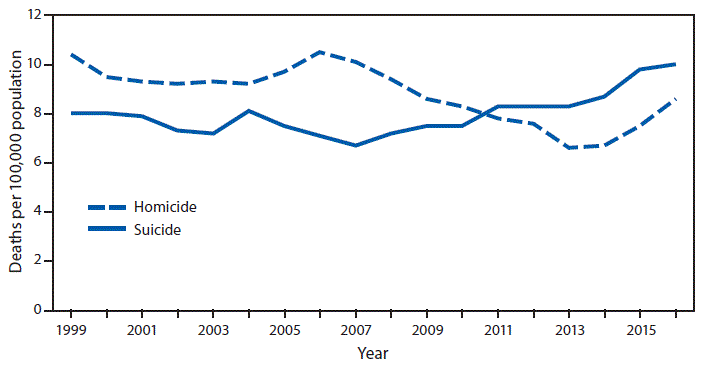
Suicide Surpassed Homicide Among Youth
More youth between 15-19 are killing themselves than each other. Homicide is on the decline as suicide is on the rise, surpassing rates of homicide after 2011. The Centre for Disease Control (CDC) published the following statistics:
The increasing rate of suicide also correlates with the increasing rate of anxiety and depression among youth. The CDC also published the following findings on youth mental health:
“’Ever having been diagnosed with either anxiety or depression’ among children aged 6–17 years increased from 5.4% in 2003 to 8% in 2007 and to 8.4% in 2011–2012.”
Statistical changes among a demographic suggest there is something going on beyond the individual. Therefore, we need to consider the broader sociological issue and look at how technological changes may be affecting youth.
Does Social Media Isolate Us?
It depends on how you use it.
Facebook’s mission is to “Give people the power to build community and bring the world closer together.” But is social media actually bringing us together?
As a sociologist, I took a look at the research, and here is what I found:
Social media use is correlated with depression and low well-being.
Yes, this conclusion itself sounds depressing, but let’s take a look at the data.
A 2016 study surveyed 1787 19-32-year-old men and women, finding social media use was “was significantly associated with increased depression.”
Another 2016 study found the following:
“Taking a break from Facebook has positive effects on the two dimensions of well-being: our life satisfaction increases and our emotions become more positive.”
Internet use is correlated with decreased loneliness among older adults.
So it’s more complicated than the above studies might suggest.
According to this 2015 study looking at individuals 65 and older:
“Higher levels of Internet use were significant predictors of higher levels of social support, reduced loneliness, and better life satisfaction and psychological well-being among older adults.”
How you use social media makes a difference.
According to another 2016 study on the correlation between Facebook and well-being, the researchers found:
“Specific uses of the site were associated with improvements in well-being.”
So what made the difference?
Individuals who used Facebook to build relationships with strong ties received the benefits, while those who used it for wide broadcasting did not. Therefore, they concluded the following:
“People derive benefits from online communication, as long it comes from people they care about and has been tailored for them.”
Another 2016 study found the same for Instagram:
“Instagram interaction and Instagram browsing were both related to lower loneliness, whereas Instagram broadcasting was associated with higher loneliness.”
Antisocial uses of social media can be addictive.
Neurological research used functional neuroimaging data to uncover the impact of Facebook use on the nucleus accumbens, the brain’s pleasure-center within the reward-circuitry.
The researchers found “gains in reputation” to be the primary reward stimulus. The brain’s mechanism for processing self-relevant gains in reputation through Facebook use mirrors the reward circuitry activated through addiction to psychotropic substances.
This reward circuitry applies to digital addictions such as Facebook through the stimulus of unexpected gains in perceived reputation when sharing a piece of content.
Likes, comments, and shares are all potential sources of these unexpected gains, stimulating the nucleus accumbens, activating the dopamine response from the VTA.
Over time, the nucleus accumbens adapts to the dopamine response, requiring increasing stimulation. This may come in the form of seeking more likes, comments, shares, or spending an increasing amount of time using social media technologies.
Social Media does not necessarily make us more ‘social’.
It can further isolate us from family, friends, loved ones, or co-workers when abused as an addiction, spurring us to spend ever-more time constructing our carefully curated online identities, constantly seeking out more ‘likes’ to validate our self-worth.
Although social media can isolate us through voyeurism and identity-construction associated with social comparison and reputational enhancement, this is not the full story.
There are many non-addictive ways social media can be used.
Social media can be social when used in social ways.
It can bring together international families grieving the loss of a loved one, connect soldiers in combat with their families back home, rekindle long-lost friendships, or as Facebook itself says:
“…help you connect and share with the people in your life.”
Social media is social when used in ways that help build deeper connections between us.
Facebook is a social media platform, but that does not necessarily mean it makes us more social. It can further isolate us from family, friends, loved ones, or co-works when overused.
In her recent book, IGen, Jean Twenge writes about the generation born after 1994, finding high rates of mental health issues and isolation:
“A stunning 31% more 8th and 10th graders felt lonely in 2015 than in 2011, along with 22% more 12th graders”…[.] All in all, iGen’ers are increasingly disconnected from human relationships.
She argues the increasing level of screen-time and decreasing level of in-person interaction leaves Igen lacking social skills:
“In the next decade we may see more young people who know just the right emoji for a situation—but not the right facial expression.”
This lack of in-person interaction leaves Igen vulnerable to mental health issues:
“iGen is on the verge of the most severe mental health crisis for young people in decades. On the surface, though, everything is fine.”
This idea that everything is fine on the surface comes from the need to present an ideal version of oneself online:
“…social media is not real life. Her photos, which looked like casual snaps, actually took several hours to set up and up to a hundred attempts to get right…”
Social media platforms encourage rampant voyeurism, drawing us into someone else’s constructed world, spurring us to spend ever-more time constructing our own carefully curated online identities for others to see.
Our friend-lists are paper-trails of past acquaintances, giving us a little window to voyeuristically peer into their lives, casually connect, or rekindle a friendship.
Paradoxically, we can feel alone in a sea of social media connections.
Like the Sociologist David Riesman’s concept of the “lonely crowd,” we are perpetually other-directed, scanning and finger-scrolling screens, searching for a kind of stimulation that never seems to fulfill our sense that we are good enough.
How Social Media Affects Self-Esteem
Picturesque portraits in Machu Picchu, selfies in the sand in Santorini, engagements, children, and new homes remind us of how we always seem to be missing out on life’s milestones and adventures.
We curate our online identities, attempting to live up to an impossible standard, ever-more concerned with our digital reputation.
According to a PEW Research report on Teens, Social Media & Technology they report the following experience of a 15-year-old girl:
“It provides a fake image of someone’s life. It sometimes makes me feel that their life is perfect when it is not.”
This perfectionism is amplified by new technology on social media platforms that automatically edit your photos. Dr. Hamlet, from the Child Mind Institute states the following:
“…there’s a so-called “pretty filter” on Instagram and Snapchat. Beautifying filters are used almost reflexively by many, which means that girls are getting used to seeing their peers effectively airbrushed every single day online. There are also image altering apps that teens can download for more substantial changes. Facetune is one popular one, but there are many, and they can be used to do everything from erase pimples to change the structure of your face or make you look taller.”
Rae Jacobson, from the Child Mind Institute, presents the experience of a young woman in the following passage:
“Look,” says Sasha, a 16-year-old junior in high school, scrolling slowly through her Instagram feed. “See: pretty coffee, pretty girl, cute cat, beach trip. It’s all like that. Everyone looks like they’re having the best day ever, all the time.”
The article goes on to describe the problem with this perfectionism is negative social comparison:
“Kids view social media through the lens of their own lives,” says Dr. Emanuele. “If they’re struggling to stay on top of things or suffering from low self-esteem, they’re more likely to interpret images of peers having fun as confirmation that they’re doing badly compared to their friends.”
The negative emotion produced by this social comparison can result in an attempt to bolster one’s low self-esteem by attempting to gain more likes on their own photos.
The problem with this short-term solution is that it creates long term problems, like any other addiction. Rae Jacobson goes on to state:
Teens who have created idealized online personas may feel frustrated and depressed at the gap between who they pretend to be online and who they truly are.
Social media is addictive because pretending to be someone else online further reinforces the idea that you are not enough. Receiving several likes is a temporary solution, but genuine self-esteem suffers in the long run.
As selfies gain popularity on Instagram the research findings from a 2017 study on the topic reveal some important lessons. Here are the highlights:
• Selfie viewing was negatively associated with self-esteem.
• Groupie viewing was positively associated with self-esteem.
• Frequent groupie viewing led to increased life satisfaction.
• Frequent selfie viewing led to decreased life satisfaction.
• Need for popularity moderated the relationship between selfie viewing and self-esteem.
• Need for popularity moderated the relationship between selfie viewing and life satisfaction.
In our selfie-obsessed Instagram culture, findings like this are important to consider. Mindlessly scrolling through Instagram selfies may be affecting us more than we think.
What Makes New Social Media Different?
I grew up in the era of MSN messenger, chat rooms, message boards, and MySpace. I remember feeling heavily drawn to connecting with my friends online, often communicating more online than in person. But these online social platforms are fundamentally different from today’s platforms.
Today’s social platforms are more than a neutral space to communicate with friends. They are miniature broadcasting platforms.
I still remember a time before the Facebook ‘like’ button. The button was introduced in 2009 and made the platform more than simply about commenting and sharing. In 2016, the ‘reactions’ button came out, further allowing users to share their emotional reactions to your content.
The ‘like’ button amplified the social comparison potential. In an article featuring an interview with Dr. Max Blumburg, he states:
“…you’re making yourself vulnerable to the thoughts of others, so it’s not surprising that if it doesn’t elicit the reaction you’d hoped for your pride takes a hit. We’re seeking approval from our peers and it’s not nice when we don’t get it – you want people to think your ‘content’ is funny/interesting/likeable. ‘If you have low self-esteem and you don’t do well on social media, you’re going to feel particularly bad.
We are all miniature media companies, in a sense. The responsibility to manage one’s reputation online has skyrocketed since the development of these advanced technologies.
The thought of having a career as a social media celebrity was unthinkable not too long ago. Now, social media influencers are a key aspect of mainstream marketing.
We’re all having to become our own marketers online. This is something I think about quite a bit, given the fact that I created this website for the purpose of sharing my ideas in non-traditional ways.
Although you can use social media to further your professional career and build connections with like-minded people, it is important to be mindful of when it is having a negative impact on your life.
If you suspect your internet use may be having a negative impact, you can try the free Internet Addiction Test here.
Getting Reconnected
As described throughout this article, social media can be an addiction, like any other substance. For those struggling with an addiction to social media, you are not alone.
This is a very common issue that can be treated through self-help activities, psychological treatments, counseling, and support groups.
If you are simply looking to prevent any issues, it could be helpful to be mindful of the way you are relating to social media. If you find you are constantly seeking likes and validation, perhaps taking a break might help you clear your head.
Finding hobbies or new activities to engage in could help build your sense of self, in addition to building an in-person peer group.
If you decide to return to social media use, it is important to set limits on how long you intend to spend on it, how often you intend on checking it, and considering whether or not you are using it in a meaningful way to connect.
It could also be helpful to turn off your push-notifications so you are not getting constant beeps or buzzes. See my article on 5 Powerful Ways to Spend Less Time on Social Media (with pictures), for some helpful tips.
If you are still having difficulties, treatment may also be helpful. Internet addiction is becoming increasingly recognized and can now be formally diagnosed in the DSM.
Treatment looks different for each individual, based on their unique experiences. Based on my research into evidence for psychotherapeutic treatments, mindfulness-based cognitive-behavioral approaches seem to have the highest level of evidence supporting their effectiveness. In addition, Acceptance and Commitment Therapy is quickly becoming an industry standard and is a personal favorite of mine.
These approaches are also effective for several other mental health conditions, including anxiety, depression, and OCD.
Conclusion
Youth experience social isolation due to the increasing dependence on technological communications at the expense of in-person interactions.
This social isolation increases the risk of suicide since the need for social connection is not being fulfilled.
Although I have focused on broader social/ technological developments here, there are many individual factors contributing to suicide as well. Mental health issues and a history of trauma are some major individual contributors.
If you want to read more on these individual factors and subjective experiences, I’ve written an in-depth article here: Inside the Mind of a Suicidal Person.
If you or someone you know is suffering from suicidal thoughts, it is important to talk to your doctor and seek psychotherapy from a qualified practitioner.
If it is a crisis, call the National Suicide Prevention Lifeline (in the US) or seek out your local Crisis Centre and speak to someone who can help.

by Steve Rose | Jul 3, 2019 | Identity, Purpose, and Belonging
On the go? Listen to the audio version of the article here:
Lately, I have been thinking about narcissism and its relationship to self-esteem. There seem to be some mixed messages going around about whether or not narcissists actually have high self-esteem.
The conventional wisdom is that narcissists are masking an underlying sense of low self-esteem. But when psychologists measure the self-esteem of a narcissist, they actually score very high. So how can we make sense of this?
Digging deep into the research on narcissism, this is what I’ve found:
Narcissists have high self-esteem. But unlike individuals with a secure sense of high self-esteem, narcissists have what researchers call “fragile high self-esteem“. It is a form of high self-esteem dependent on external validation and self-deception.
Let’s take a closer look at the research to unpack what this means. Also, if you or someone you know is struggling with mental health issues, you can check out my resource page for suggestions on how to find help.
How to Recognize Fragile High Self-esteem
Self-esteem can be understood as one’s valuation of one’s own worth. This sense of one’s value can rest on a secure foundation, or it can be fragile and dependant on constant external validation. Fragile high self-esteem can be distinguished by the following traits:
1. Defensiveness: this involves a defensive attitude toward preserving one’s self-image. A narcissistic fixation on image preservation can quickly result in defensive attacks if this image is threatened. Verbal defensiveness is one key indicator of fragile high self-esteem. It may feel like you are constantly walking on eggshells around someone with narcissistic fragile high self-esteem.
2. Validation Seeking: Research distinguishing fragile high self-esteem from secure high-self esteem also points out how fragile self-esteem is dependent on external factors. These factors can include the need for praise, compliments, or recognition. Without this validation, self-esteem begins to erode, triggering a narcissistic individual to seek out new sources of validation.
3. Unwillingness to learn from mistakes: Being able to listen and accept constructive feedback is a trait associated with secure high self-esteem. When self-esteem is fragile and dependant on constant validation, constructive feedback can be easily perceived as a slight against one’s image, often resulting in defensiveness and an unwillingness to accept the feedback.
4. A sense of superiority, dominance, or entitlement: Individuals with fragile high self-esteem often regard themselves as superior to others. This can manifest as attempts to display dominance or displays of entitlement where the individual believes they are owed special privileges.
Narcissism is an Addiction to Esteem
At its most extreme, narcissism can manifest as a narcissistic personality disorder, having severe consequences on one’s life, similar to an addiction. Researchers have actually argued that narcissism functions like an addiction in multiple ways:
The craving for esteem may lead to a cycle of escalating tolerance and occasional, bitter withdrawal. The instability of narcissists’ self-esteem and relationships could be understood as resulting from these cycles.
1. Cravings: Narcissistic cravings include the drive to constantly maintain an inflated grand view of oneself. This is a view of oneself is based on distorted thinking patterns, maintaining a positive self-evaluation that is unrealistic to the person’s interpersonal reality.
Like an addiction, narcissism is generally met with disapproval from others. Although this is the case, narcissistic individuals can distort their perception of what others think of them. In this way, they can falsely believe in the approval of others, effectively giving themselves the drug of validation.
2. Tolerance: Like an addiction, tolerance is also a feature of narcissism. Narcissists constantly seek out ways to raise their sense of specialness. There is never enough. Like an addiction, the person can chase the high provided by the substance into infinity. Opiate overdoses are often the result of this pursuit of the infinite. In the case of narcissism, the infinite pursuit of self-esteem can lead to extreme behaviors.
3. Withdrawal: Like an addiction, narcissists experience withdrawal when their fragile self-esteem begins to collapse. It can provoke aggressive hostile reactions or extreme defensiveness. In the midst of a collapse, some narcissists may even swing wildly between statements consistent with low self-esteem, validation seeking, and defensiveness.
How to Develop Non-narcissistic Secure Self-Esteem
Before considering how to develop secure self-esteem, we need to consider why self-esteem is important. There has been a recent backlash against the self-esteem movement due to its ineffectiveness.
The problem with critiques of self-esteem promotion is that they often neglect to define self-esteem. As described above, there are many different ways of defining the concept. Secure self-esteem and fragile self-esteem are radically different manifestations of self-esteem that cannot be equated.
Critiques of self-esteem promotion are accurate when discussing simple tactics like positive affirmations and participation ribbons. These tactics only work to promote fragile high self-esteem.
Rather than developing a fragile false sense of self-esteem, one can develop secure self-esteem through genuine connection with oneself and others.
In The Six Pillars of Self-esteem, Nathaniel Branden presents a concept of secure high self-esteem. He argues that self-esteem consists of the following practices:
1. The Practice of Living Consciously: This involves being more aware of what drives our actions, bringing mindful awareness to these underlying motivations so we can act in accordance with our values. Living unconsciously is like sleepwalking through life. You go through the motions, reacting to negative stimuli with a fight or flight response.
Fragile high self-esteem is built on living unconsciously. It is based on a form of self-deception regarding one’s own sense of self. Rather than seeing the underlying behavioral motives and the impact it has on others, fragile high self-esteem maintains unhealthy relational dynamics.
Ineffective patterns of behavior are maintained because bringing conscious awareness to the reality of the situation would threaten the narcissistic identity. It is easier to simply blame others for any hardships than to take responsibility for one’s actions.
Living consciously involves being able to accept feedback, remaining open to learning about your unconscious motives and shortcomings. It then involves acting mindfully, consciously choosing your reaction to situations, rather than simply reacting in the moment based on fear and anger.
2. The Practice of Self-Acceptance: This means letting go of an adversarial relationship to oneself. In The Confidence Gap, Russ Harris argues self-acceptance is the most important aspect of building true confidence. When we have an adversarial relationship with ourselves, we constantly battle or deny our uncomfortable thoughts or emotions. Self-acceptance means consciously being aware of the things you are resisting, in addition to letting go of this resistance.
Fragile high self-esteem is built on a foundation of denial and resistance. Rather than accepting one’s shortcomings, they are resisted through the armor of false self-worth. Self-acceptance requires letting go of this armor.
3. The Practice of Self-Responsibility: This can be understood by breaking the word into two parts, “response” and “ability”. It is the ability to respond appropriately to situations. For example, if you are responsible for your team at work, it means you must be able and ready to respond to the needs of the team to the best of your ability.
Before taking on responsibility for others, one must first take on self-responsibility. This means being able to respond to your own unmet needs. After being conscious of your own unmet need and acceptance of your situation, self-responsibility means having personal boundaries and working to take care of your own unmet needs so you can develop your skills and ability to be responsible for others.
4. The Practice of Self-Assertiveness: This means being able to speak the truth, as you understand it, rather than trying to deceive yourself or others. A lack of self-assertiveness could mean denying your needs, not communicating personal boundaries, and telling everyone that everything is okay when it is not.
Fragile high self-esteem, on the other hand, is aggressive rather than assertive. Assertiveness comes from a foundation of secure self-esteem whereas aggression comes from fear. Aggression is defensive and biting in tone whereas assertiveness is proactive and neutral in tone.
5. The Practice of Living Purposefully: This means having a sense of purpose. A sense of purpose built on secure self-esteem means having taken care of your own needs, then making yourself useful to others. This is something I explore further in my article, “What Does It Mean to Have a Purpose?“.
Low self-esteem can lead to codependency, which is a false sense of purpose consisting of constantly doing things for other people at the expense of your own needs. It prevents you from developing your potential since you are not focusing on developing your own skills or taking care of your own needs.
Insecure high self-esteem is also a form of false purpose since one’s purpose is completely intertwined with seeking validation and maintaining one’s image.
6. The Practice of Personal Integrity: This means living in alignment with your values. If your behaviors match your values then you are living with personal integrity. By living with integrity, you gain self-worth, knowing you have acted in accordance with your values. Although it may be easy to fool others, you cannot fool yourself. Deep down, we know when we have deceived ourselves.
Conclusion
In the book, Rethinking Narcissism, Craig Malkin argues that genuine connection is the antidote to narcissism. Since this site is dedicated to the power of social connection, this is something I completely agree with. If you are interested in learning more, I highly recommend checking out his book. You can get the audiobook here.
Since narcissistic individuals have fragile high self-esteem, they are always on the defense against potential threats to their self-esteem, creating a barrier to genuine connection.
Codependent persons on the other end of the spectrum have the opposite issue, but the result is often the same. Due to fragile low self-esteem, they often constantly do things for others at their own expense, creating a barrier to genuine connection by not letting others help them.
Rather than viewing narcissism as high or low self-esteem, I have found it useful to distinguish between fragile and secure self-esteem instead.
If you found this article useful, let me know what you liked in the comments section below.
If you have a more personal question and would like to get in touch, feel free to send me a message in my contact section.

by Steve Rose | Jun 19, 2019 | Addiction and Recovery
On the go? Listen to the audio version of the article here:
In recent years, the recovery model, or recovery approach, has become widely popular in addiction and mental health treatment systems. This shift has come as part of a broader social movement away from long-term institutionalization of persons with addictions or mental health issues.
I thought I would summarize what I’ve recently learned about the recovery model since I’ve been coming across it more frequently lately in the health care setting. I believe the recovery model is changing the way addiction is dealt with and hope that its principles continue to become widely adopted in the field.
What Is The Recovery Model?
According to The Substance Abuse and Mental Health Services Administration,
“Recovery is a process of change through which people improve their health and wellness, live self-directed lives, and strive to reach their full potential.”
This means treatment is focused on empowering people to support their own self-directed path of recovery. In doing so, the person is supported so they can reach their full potential.
This approach is distinct from authoritarian approaches to treatment whereby the individual is prescribed a rigid path of recovery, in addition to a narrow definition of what a successful recovery means.
Supporting someone with an addiction based on a recovery approach involves four components:
Health: The person’s health is considered by managing any diseases and supporting activities that allow them to physically and emotionally flourish.
Home: The person’s sense of safety and security is considered, supporting their sense of a stable place of residence.
Purpose: The person’s sense of purpose is considered, supporting their sense of meaning and contribution to their broader social context.
Community: The person’s sense of community is considered, supporting their sense of belonging and social connection.
What Are The Guiding Principles of Recovery?
According to the SAMHSA, there are ten guiding principles of recovery:
1. Recovery is person-driven. This means allowing the person to drive their own recovery, including defining their personal goals for recovery. It means supporting their autonomy, allowing them to take action without coercion or manipulation.
2. Recovery is supported by addressing trauma. This means understanding addiction as a common response to coping with traumatic events in one’s life. Creating a safe, non-judgmental environment allows the person to feel comfortable sharing these underlying issues.
3. Recovery emerges from hope. This means supporting hope by helping the person break down their long-term recovery goals into short-term manageable ones, making the process seem more realistic and clear.
4. Recovery is based on respect. This means maintaining an attitude of respect toward the person without the attitude of judgment or blame that can further stigmatize the individual, driving them into further isolation.
5. Recovery is culturally based and influenced. This means considering the person’s culture in supporting their treatment. It also means adopting their own understanding of their culture rather than your own predetermined idea of it.
6. Recovery is holistic. This means considering the biological, psychological, and social forces involved in recovery, supporting healthy development in each of these domains.
7. Recovery occurs via many pathways. This means there are multiple paths to recovery, and each person needs to be supported in their own path, whether it involves abstinence-based practices or harm reduction. Also, various therapeutic styles need to be considered since no one method is appropriate for every person.
8. Recovery is supported by peers and allies. This means recognizing the role of peers who are in various stages of their own recovery from similar issues. The recovery model makes the distinction between experts by profession and experts by experience. Both are considered valuable.
9. Recovery is supported through relationship and social networks. This means recognizing the power of social connection, considering ways to support the person by facilitating further social ties to develop a sense of belonging.
10. Recovery involves individual, family & community strengths & responsibilities. This involves supporting the person in their social roles, allowing them to maintain a sense of purpose through family connections or contribution to a broader community.
Does The Recovery Model Work?
Research on the recovery model supports its effectiveness. According to a 2010 study on treatments for Schizophrenia:
“A growing body of research supports the concept that empowerment is an important component of the recovery process and that user-driven services and a focus on reducing internalised stigma are valuable in empowering the person with schizophrenia and improving the outcome from illness.”
According to a Systematic Review on the recovery model:
“The recovery processes that have the most proximal relevance to clinical research and practice are: connectedness; hope and optimism about the future; identity;
meaning in life; and empowerment (giving the acronym CHIME)”
The recovery model is distinct from models of addiction treatment based on confrontation and strict authoritarian control. Approaches based on confrontation have been largely discredited and are often harmful.
According to the book, Treating Addiction: A Guide for Professionals:
“The American detour into a denial-busting confrontational style for addiction treatment was, from our perspective, an aberrant wrong turn justifying treatment practices that would be blatantly unprofessional and unethical in any other area of health care, and clinical trials of such approaches have yielded uniformly negative results”
The recovery model is an effective approach to addiction treatment because it fosters a person’s internal locus of control, intrinsic motivation, and a sense of self-efficacy.
An internal locus of control means a person has the sense that they are in control of their life. This is important because someone suffering from an addiction is experiencing the complete opposite. Addiction can enslave someone, taking away their sense of control.
The principle of person-driven recovery places responsibility on the other person for their recovery, allowing them to practice taking control over their life. An internal locus of control develops as a byproduct of rising to the occasion and noticing the small wins.
The recovery approach also develops a person’s sense of intrinsic motivation. This is the most powerful form of motivation. It is a person’s deep internal drive, distinct from extrinsic motivation, which is only based on a person’s desire for an external reward or to avoid punishment.
Trying to make someone change through manipulative rewards or punishments may work, but the result is often temporary. Once the external force is removed, the person resumes old habits. The person-driven principle in the recovery approach fosters this internal drive for recovery, leading to long term success.
The recovery approach is also effective because it develops a sense of self-efficacy. This is the sense that you can achieve success, as opposed to the sense that you are helpless. Someone suffering from addiction may often experience a sense of helplessness when it comes to recovery.
The person-driven approach combats a sense of hopelessness and helplessness by empowering the person to actively direct their recovery, allowing them to gain a sense of accomplishment along the way, building their trust in their own capacities.
How Do You Implement The Recovery Model?
All of this probably sounds pretty good, but you may be wondering how you actually do a recovery approach. The recovery model is fairly abstract and philosophical, but it is meant to be guiding spirit for existing treatment tools and techniques, not a treatment method on its own.
In other words, the recovery model is a broad overall approach to compassionate person to person relationships and can be applied through Evidence-Based Practices in addiction treatment.
The evidence-based technique of Motivational Interviewing is highly compatible with the recovery model in addiction treatment. The spirit of motivational interviewing is deeply aligned with a recovery approach. As stated by its founders:
“Motivational interviewing is a way of being with a client, not just a set of techniques for doing counseling.”
On a technical level, it involves engaging the person through active listening, asking open-ended questions, encouraging them to talk about their desired goals, and collaborating with the person to support them as they begin taking action toward these goals.
I discuss specific techniques adopted from the motivational interviewing literature in my article, “The Ultimate Guide to Helping Someone Change.”
For a detailed tutorial of motivational interviewing techniques, I highly recommend doing the free online modules hosted by the British Medical Journal: Motivational interviewing in brief consultations.
Conclusion
The recovery model has been transforming addiction and mental health treatment, offering a more effective and humane approach to working with persons who are interested in improving the quality of their lives.
It recognizes the value of overall health, a stable home, a sense of purpose, and a sense of community belonging and support.
If you’re interested in reading more on this topic, I’ve recently written an article, “How to Help Someone With an Addiction,” describing a recovery approach to supporting a loved one or a client. It is applicable for non-professionals and professionals working in the field.
If you are interested in obtaining professional training in the recovery model in addiction, you can sign up for the NAADAC Recovery to Practice (RTP) Certificate Program.